Home/Shop Time
A week in
the shop
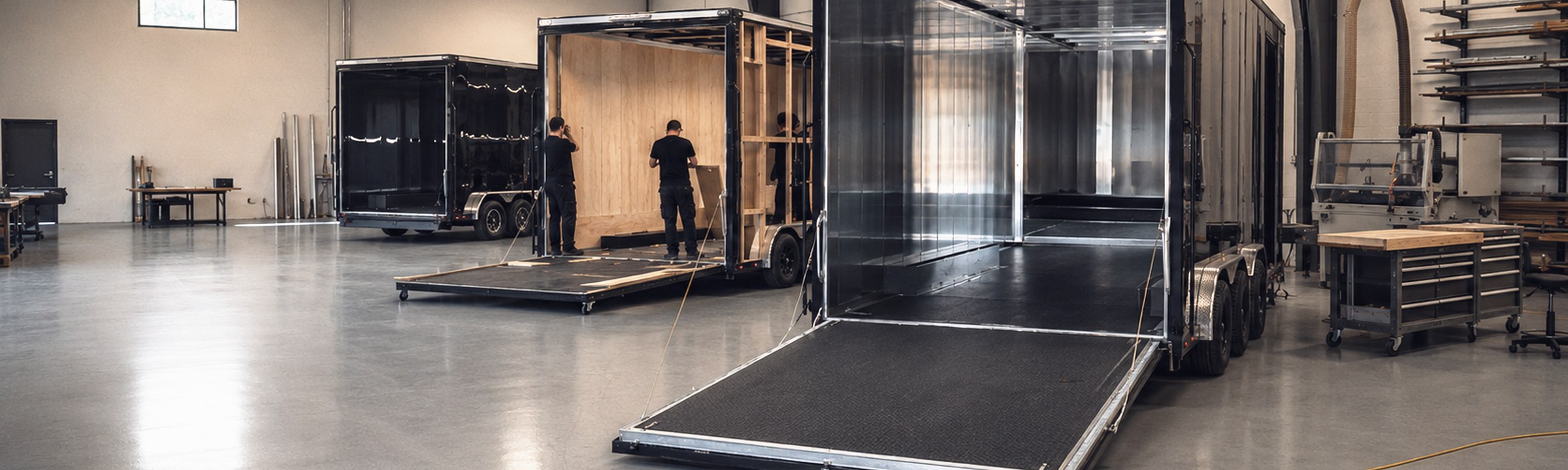
Your shell is ordered from the factory to your spec. What happens after it lands in Napa is ours: five to ten days in a bay, depending on how much you asked for.
Your shell is ordered from the factory to your spec. What happens after it lands in Napa is ours: five to ten days in a bay, depending on how much you asked for.
Not a marketing timeline. This is what happens to your trailer between the day it lands in Napa and the day you tow it away.
Your shell arrives from the factory built to the spec you signed off. First thing we do is go over it: every seam, every light, every latch, the floor, the ramp springs. Factory trailers are good but they are built fast, and it is far easier to sort a sticking lock now than with a tool wall bolted in front of it.
Anything wrong at this stage is the factory’s problem, not yours. We deal with them, not you.
Racks, stands, brackets and the bench frame are cut, welded and powder-coated on our own bench, off the trailer. The cut list comes straight from the drawing you approved, so there is no step where somebody’s reading of “about four feet” becomes a problem.
Building this off the trailer rather than inside it is slower to set up and considerably more accurate — which is the whole point of the exercise.
Wall and ceiling panels, insulation if you specified it, and the rubber coin floor laid over the sealed factory ply. Then the tool wall goes up, on the side opposite your door so you are not walking round a kart to reach a socket.
This is the week you are most welcome to drive up. Plenty of people move something twelve inches at this stage, and that is exactly what we are for.
Kart stands set to your chassis height, tire racks to your compound, engine bench at the height you actually work at rather than a catalogue number, cabinets, fuel station, chocks. The part that turns a cargo box into a race trailer.
Every stand and rack is powder-coated in your team colours at no extra cost. The powder is the powder whatever colour it is.
12V and 110V looms, labelled end to end, fused and diagrammed. Shore power gets tested under real load rather than just checked for continuity, because a 50A inlet that reads fine on a multimeter can still trip with a compressor running.
You leave with the schematic. That matters if you are three states away and something needs attention on a Saturday.
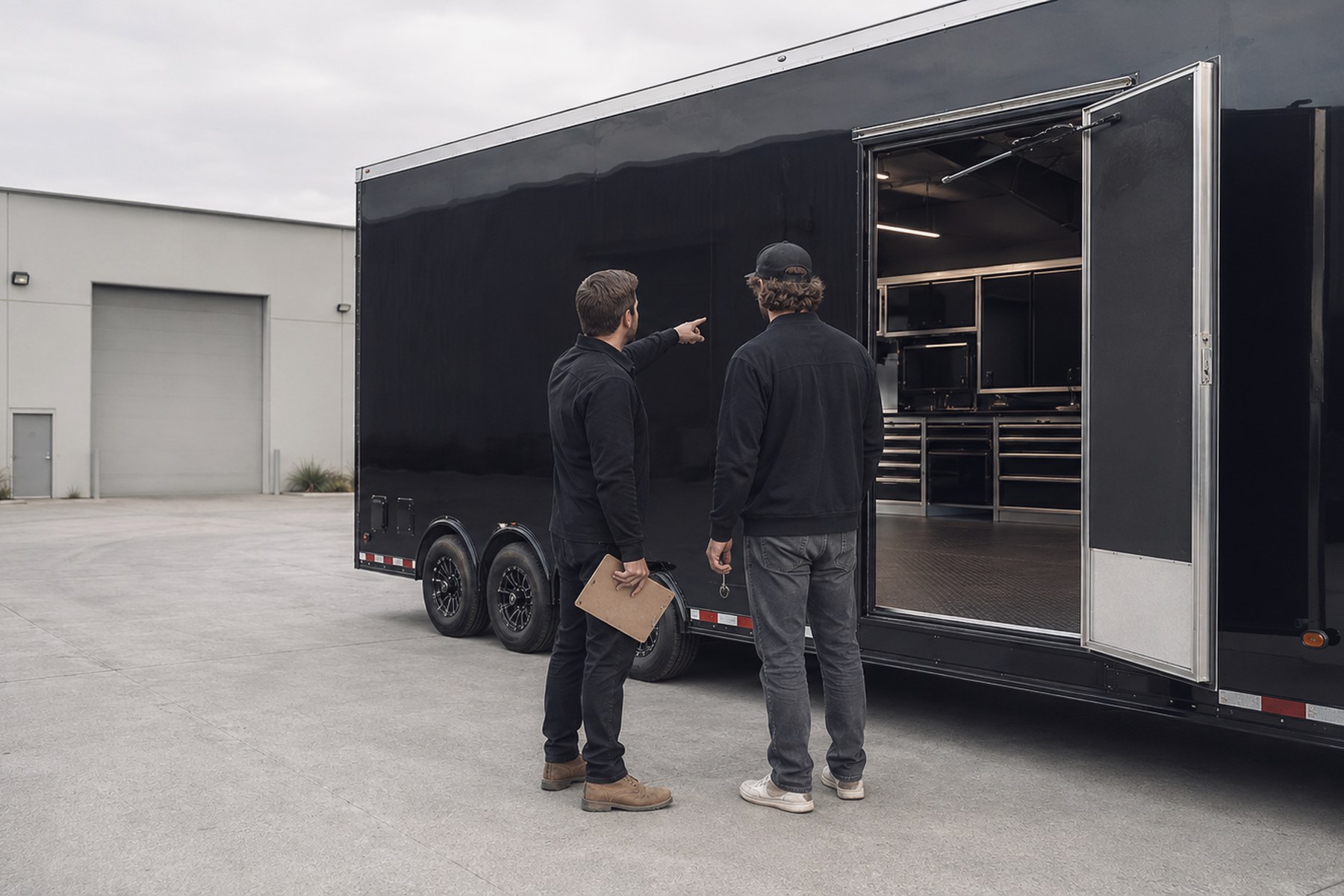
We walk the whole trailer together in the shop. Every latch, every circuit, every strap point, the factory warranty paperwork and ours. Then you get the schematic, the keys, and you tow it home.
Factory warranty on the shell, ours on everything we fitted. If something we built needs attention, it comes back to Napa.
If you cannot get to Napa, one of us hitches your trailer to our truck and drives it to your door — then does the same walk-through in your driveway. We do not hand your build to a broker, a carrier or a driver we have never met. Free inside 100 miles, a dollar a mile after that.
The person who wired it is the person who delivers it. That is the only way the handover is worth anything.
They are not, really. The actual metalwork on a race trailer is not a six-month job for anybody, including them. What takes six months is the queue.
A national manufacturer schedules four hundred units through a single production line. When you place an order you are not waiting for your trailer to be built — you are waiting for three hundred and eleven other trailers to be built first. Almost none of that time is work on your unit.
We sell slots instead of positions in a queue. There is a fixed number each month, and when you take one, your trailer occupies a bay from the day it lands until the final walk-through. Nothing displaces it. That is the whole trick, and it is why we cannot simply scale up without becoming the thing we are trying not to be.
Honesty requires the other side of this. We build a small number of trailers a year. If all the slots for a month are taken, you wait for the next month — and in a busy season that can be six or eight weeks before your shell even ships. We will always tell you the real date on the first call rather than after the deposit.
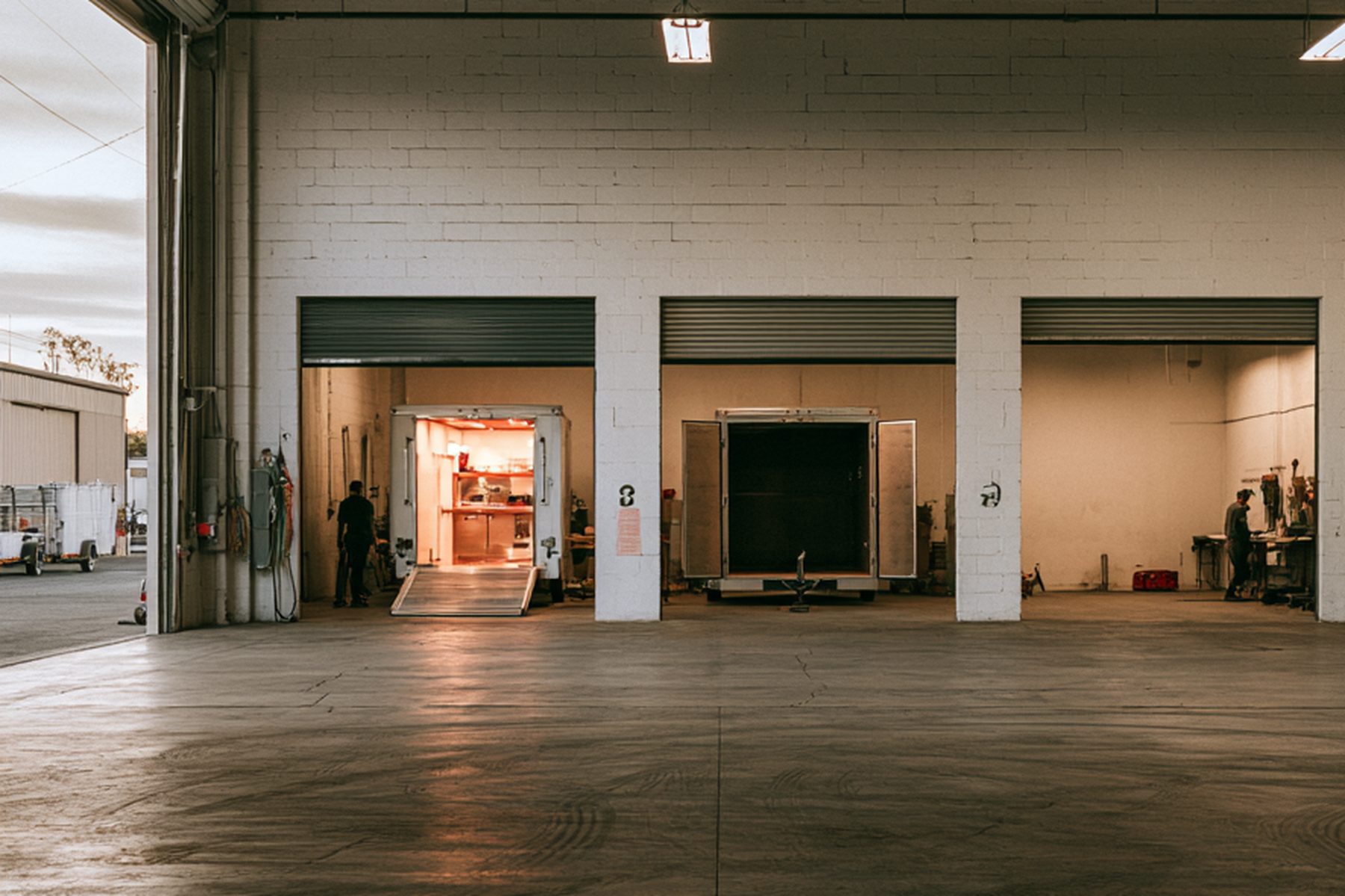
Every other shop hands your finished trailer to a transport broker and stops caring. We do not use carriers, brokers or third-party haulers at all — your trailer is towed to you by one of the five people who built it, at what we think is the lowest delivery rate in the country.
A commercial carrier quoting a 24 ft enclosed trailer from Northern California to Los Angeles will normally come back somewhere between $900 and $1,400, plus a broker’s cut, plus a window of “sometime next week”. We charge $330, we tell you the day, and you get an hour of walk-through at the other end instead of a signature on a bill of lading.
The reason we can do it is the same reason everything else here is cheap: there is no middle. We are already driving to races most weekends. Your trailer is not a freight job we have to make a margin on, it is the last stage of a build we have been standing next to for a week.
Delivery is scheduled, not instant. We tow it in the days after your handover date, around the race calendar. Tell us where you are on the first call and we will give you a date at the same time as the price — and if you happen to be racing the same weekend we are, we will simply bring it to the paddock and hand it over there.
| From Napa to | Road miles | Delivery |
|---|---|---|
| Sonoma Raceway | 25 mi | Free |
| San Francisco | 55 mi | Free |
| Sacramento | 60 mi | Free |
| Fresno | 230 mi | $130 |
| Los Angeles | 430 mi | $330 |
| Las Vegas | 570 mi | $470 |
| Portland, OR | 640 mi | $540 |
| Phoenix, AZ | 790 mi | $690 |
One-way road miles, rounded. Your exact figure is confirmed in writing with the quote, before you pay anything. The configurator works it out for your own address →
Tell us how you race and we’ll come back within one business day with a layout drawing and a fixed price.